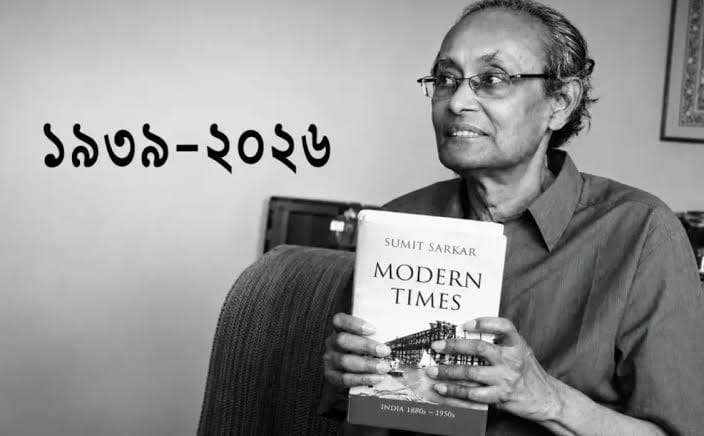
When Professor Sumit Sarkar passed away in August of 2026, the Indian historical fraternity did not merely lose a venerable elder statesman of the archives; it lost its most exacting conscience. In an era where history is routinely weaponized for political expediency, where the past is either sanitized into mythology or compressed into digestible WhatsApp forwards, Sarkar stood as a formidable bulwark of rigorous, uncompromising empirical truth. He was a rare breed of historian, one who possessed the intellectual agility to map the sweeping grand narratives of the subcontinent, yet retained the microscopic empathy required to spot the forgotten peasant, the striking mill worker, and the marginalized tribal in the footnotes of imperial records. His demise is a profound loss, creating a silence in the corridors of South Asian historiography that no amount of modern academic theorizing can adequately fill.
To understand the sheer magnitude of Sumit Sarkar’s contribution, one must first understand the stagnant waters of Indian history before he, and a handful of his contemporaries, decided to disturb them. For decades, the narrative of modern India was neatly bifurcated. On one side stood the imperialist historians, largely emanating from Cambridge, who viewed the Indian national movement as a squabble among self-interested native elites hungering for the spoils of power. On the other side were the nationalist historians, who painted a hagiographic, unblemished picture of a unified subcontinent marching triumphantly toward freedom behind a vanguard of flawless, English-educated leaders. Sarkar, armed with a staggering command over primary sources and a deeply internalized Marxist analytical framework, found both versions fundamentally impoverished. He recognized that both schools shared a fatal flaw: they were incurably elitist. They observed the theater of history solely from the Viceroy’s balcony or the Congress President’s podium. Sarkar decided to look at the streets, the fields, and the factory floors.
His academic journey, rooted deeply in the vibrant, fiercely argumentative intellectual milieu of Presidency College and the University of Calcutta, instilled in him a profound suspicion of unchallenged orthodoxies. This skepticism found its most brilliant early articulation in his pioneering 1973 work, The Swadeshi Movement in Bengal, 1903–1908. For anyone attempting to unravel the complex, often contradictory threads of Bengal’s political past—especially the communal and class fissures that would eventually culminate in the tragedies of 1947—this book remains the absolute bedrock. Before Sarkar, the Swadeshi movement was largely romanticized as a golden dawn of Bengali patriotism. Sarkar, with the cool detachment of a surgeon and the wry wit of a seasoned observer, dissected the movement to reveal its stark limitations. He demonstrated how the elite, Hindu bhadralok leadership completely failed to integrate the Muslim peasantry and the lower-caste agrarian classes into their grand vision. By forcing historians to confront the class and communal fault lines of early twentieth-century Bengal, Sarkar laid the groundwork for a far more honest, albeit uncomfortable, understanding of the region’s fractured destiny.
It was, however, the publication of Modern India: 1885–1947 in 1983 that cemented his reputation not just as a scholar’s scholar, but as a master synthesizer capable of speaking to the wider public. If one were to point to a single volume that revolutionized how Indian history was taught in universities across the globe, this is it. In a stroke of brilliant historiographical defiance, Sarkar shifted the center of gravity away from the constitutional wrangling in London and Delhi. Instead, he wove the autonomous, often spontaneous rebellions of the subaltern classes—the tribal uprisings, the peasant revolts, the labor strikes—into the very fabric of the national movement. He showed us that the Indian masses were not merely an inert clay molded by the hands of Gandhi or Nehru; they had their own agencies, their own radical demands, and their own visions of freedom, which often made the elite Congress leadership profoundly uncomfortable. He painted a picture of a nation pushing against the empire from below, forcing the leadership to either run to catch up with the masses or scramble to contain their revolutionary fervor.
Yet, perhaps the most defining trait of Sumit Sarkar’s personality was his absolute refusal to become a prisoner of his own intellectual legacy. He was fiercely independent, possessing a mind that was always moving, always questioning, and never settling into the cozy armchair of academic dogma. This was most famously demonstrated in his relationship with the Subaltern Studies collective. In the late 1970s and early 1980s, Sarkar was one of the founding pillars of this revolutionary project, collaborating with figures like Ranajit Guha to dismantle elite historiography and write a genuine ‘history from below’. However, as the 1990s progressed and the collective took a sharp turn toward postmodernism and cultural studies—often at the expense of analyzing hard material realities, political economy, and class dynamics—Sarkar did something that requires immense intellectual courage. He walked away from the very movement he had helped build.
His subsequent critiques of the late Subaltern Studies project were devastating in their precision. With a sharp, slightly sardonic wit, he pointed out the irony of radical historians becoming so obsessed with discourse and textual deconstruction that they had effectively lost sight of the actual, living, breathing poor. He argued passionately against what he termed the ‘decline of the subaltern’, warning that ignoring the material conditions of exploitation in favor of purely cultural or linguistic analysis was a betrayal of the historian’s duty. This public intellectual divorce was not a matter of petty academic squabbling; it was a profound defense of history as an empirical discipline grounded in human suffering and economic reality. Sarkar possessed an old-school reverence for the archives. He believed that while theory is necessary to interpret facts, theory without facts is little more than intellectual vanity.
Beyond the library and the lecture hall, Sarkar was a public intellectual in the truest sense, demonstrating that a historian’s duty to truth does not end at the borders of the past. Alongside his formidable partner, the brilliant historian Tanika Sarkar, he consistently stood against the rising tide of communalism and majoritarianism in India. Their co-authored tract, Khaki Shorts and Saffron Flags, remains a masterclass in dissecting the historical and ideological roots of the Hindu Right. Sarkar brought his forensic historical skills to bear on the politics of the present, exposing how historical memory was being cynically fabricated to serve contemporary political agendas.
His moral compass was as unwavering as his scholarship. Though a lifelong Marxist who applied historical materialism with unparalleled sophistication, he never allowed ideology to blind him to the failures of the Left. When the Left Front government in West Bengal unleashed violence upon the peasantry in Nandigram in 2007 to acquire land for industrialization, Sarkar did not hesitate to speak out. In a gesture of profound protest that resonated across the country, he returned the prestigious Rabindra Puraskar he had been awarded for his magisterial book Writing Social History. He noted with biting irony and deep sorrow that he could not, in good conscience, hold an award from a government that claimed to represent the working classes while shedding the blood of marginalized farmers. It was a moment that perfectly encapsulated the man: fiercely principled, devoid of hypocrisy, and always, instinctively, on the side of the oppressed.
As we look back at the vast expanse of his life and work, the magnitude of his absence becomes glaringly apparent. We are currently living through an epoch where the writing of history has increasingly become a battleground for state-sponsored myth-making, where the complexities of the past are being actively flattened into a monolithic, homogenous narrative. In such times, Sumit Sarkar’s methodology is not just a tool for academic research; it is an act of democratic resistance. He taught generations of students, scholars, and readers that true history is invariably messy. It is full of contradictions, betrayals, unfulfilled promises, and suppressed voices.
Sarkar leaves behind a legacy that challenges us to look beyond the obvious, to question the sources of our historical knowledge, and to always seek out the silences in the archives. He taught us that the true measure of a society is not found in the grand proclamations of its rulers, but in the struggles of its most vulnerable citizens. For those committed to understanding the fractured, deeply complex realities of modern South Asia—whether tracing the agonizing lines of the 1947 Partition or analyzing the contemporary currents of regional politics—his books will remain indispensable companions. Sumit Sarkar did not just write the history of modern India; he taught us how to read it, how to question it, and, most importantly, how to protect it from those who would seek to erase its glorious, infuriating complexities. He was a giant of his craft, a historian of the people, and his departure leaves a void that will be felt for generations to come.