Nandini Sahu
There are festivals that one celebrates. And there are festivals that one inhabits. For me, Dussehra belonged to the second category.
It did not happen at Udayagiri merely as a festival marked on the calendar. It always came as a smell, a sound, a colour, a kitchen full of steam, six girls fighting over mirrors, new clothes folded carefully on a bed, sweets cooling on steel plates, my mother’s impatient voice travelling from the kitchen to every corner of the house, and my father’s measured voice reading aloud the Sudasha Brata Katha. It arrived with the distant beat of the dhol. And, sometimes, with the sudden, terrible cry of a goat. Even now, after all these years, I can hear both. Udayagiri was our universe then. We did not know that one day we would leave it.
We did not know that the house which contained our laughter would eventually become an old, dilapidated structure, slowly surrendering itself to dust, rain, moss, and memory. We did not know that the six daughters would scatter across cities and countries, building lives of our own. We did not know that Baba would one day be gone, leaving behind an absence too large for any house to contain. We only knew that Dussehra was coming. And that meant new clothes.
For six sisters, new clothes were not simply clothes. They were an annual declaration that life had been generous to us once again. The dresses would arrive wrapped carefully, and the six of us would examine them with the seriousness of cabinet ministers discussing national policy. Someone’s dress would invariably be considered prettier than someone else’s. Someone would complain that her sister had received a better colour. Someone would hold a dress against herself and turn before the mirror. Someone would secretly touch another sister’s fabric and declare that hers was softer.
And then, inevitably, there would be negotiations. Six sisters meant six opinions, six temperaments, six versions of justice. We were a small parliament without a constitution. The oldest sisters behaved as though they had inherited administrative powers. The younger ones challenged those powers. There were arguments, alliances, accusations, and temporary treaties. Five minutes later, we would be sitting together, sharing something sweet.
That was our childhood. We quarrelled intensely and loved instinctively. We were never alone. Perhaps that is why loneliness, when it came much later in life, felt so unnatural.
On Dussehra mornings, the house transformed. Maa began cooking long before the rest of us had fully awakened. She seemed to possess an inexhaustible capacity for work. Her hands moved continuously—washing, cutting, grinding, stirring, frying, arranging. The kitchen became her kingdom, and on festival days, we became her reluctant but willing subjects. She was not a euphonic woman. She was rather cacophonic. I must say this honestly because a memoir is not the place for convenient mythology. Maa could be impatient. Her voice could rise. Her instructions could sound like commands issued during a military emergency. If one of us disappeared when work had to be done, she would find her.
But beneath that severity was an extraordinary tenderness. She cooked for us. She cared for us. She worked until exhaustion. And on Dussehra, exhaustion seemed to become another ingredient in the food she prepared. We helped her throughout the day, washing utensils, arranging things, bringing ingredients, cleaning, carrying plates, and attending to the endless small requirements of a household preparing for guests. Sometimes we helped willingly. Sometimes we helped because Maa’s eyes told us that refusal would be a foolish experiment. And sometimes we helped while laughing. That laughter mattered. The kitchen was never entirely silent. Someone was always telling a story, teasing another sister, stealing a sweet, being caught, pretending innocence, and then being exposed by another sister.
There were cakes, pitha, and sweets made at home. The word cake itself carried a certain magic for us. Today, cakes can be ordered with a few taps on a phone. In our childhood, a homemade cake was an event. Its arrival from the kitchen seemed almost ceremonial. We waited. We watched. We calculated. Could we take one piece? Could we take another? Would Maa notice? She always noticed.
There were sweets, too, plates and plates of them. Festival food had an abundance that seemed almost limitless to a child. The house smelled of sugar, ghee, spices, and fried delicacies. The fragrance travelled beyond the kitchen, through the rooms, through the courtyard, and perhaps even into the street. And relatives came. Friends came. Neighbours came. People entered and left, greeted each other, talked, laughed, ate, blessed us, asked us questions, admired our dresses, and commented on how much we had grown. For a few days, our house became a crossroads. Everyone seemed to know everyone. There was no concept of privacy. There was only family. And family, in those days, was a word much larger than it is today. It included relatives, neighbours, friends, visiting elders, familiar faces from the locality, and the invisible network of affection that held a small town together.
In the midst of all this movement sat Baba. He was the still centre of our noisy universe. My father was a high-school teacher. But to me, as a child, he was much more than that. He was our benevolent God. Not the distant God of temples. Not the God who sat beyond clouds and listened to prayers from a great cosmic distance. Our God lived in our house. He read. He taught. He protected. He watched. He had faith in his daughters. Six daughters. No son. In a society where the absence of a son could be treated almost as a family tragedy, Baba never made us feel that we were an incomplete family. We were his children. That was enough.
On Dussehra, one of the memories that returns to me most vividly is Baba reading aloud the Sudasha Brata Katha and Durga Stotram. We had to listen. We had to sit straight. We had to understand. We had to accept. Those were the rules. Baba’s voice carried through the room as he read the story. I listened differently from the others. Even as a child, I had begun to wonder about the meanings beneath the meanings. Why were these stories told to us? What did they ask women to believe? What did they ask them to endure? What did they promise? What did they fear? What did they conceal? The surface meaning was one thing. The internal meaning seemed to me another. I did not have the vocabulary then for feminism, patriarchy, gendered ritual, cultural memory, or the politics of religious narratives. I only had questions. Perhaps scholarship begins there. Perhaps the first academic question is simply the refusal to accept the surface as the whole truth. While Baba read, we listened. But I was also thinking. The other sisters perhaps heard a story. I heard a structure. I heard rules. I heard expectations. I heard the voices of women who had lived before us. I heard the quiet instructions by which a girl was taught what a good woman ought to be.
And yet, paradoxically, the voice that carried those traditional words belonged to the man who had given his six daughters something radically liberating for his time: the right to education, dignity, and possibility. That contradiction fascinates me even now. Baba could read traditional texts to us and simultaneously open the doors of modernity for us. He belonged to his time. And yet, in some profound ways, he was ahead of it.
Outside the house, another world was unfolding. The Dussehra of Udayagiri was not just about prayer and sweets. There were processions and groups moving towards the places of sacrifice. There was the dhol, sometimes distant, sometimes suddenly near. Its rhythm of ululation would travel through the air. Those high, piercing cries seemed to rise from somewhere beyond the ordinary world. As children, we did not possess the cultural vocabulary to understand the ritual complexity of animal sacrifice. We understood only fear. The sounds frightened us. Sometimes we heard the cries before we saw anything. That was enough. We would look at one another. And sometimes, when the sound became unbearable, six sisters would suddenly lose all their arguments and become one frightened body. We hid behind our parents. There was something deeply instinctive about that movement. When the world became frightening, we returned to them. Baba. Maa. Our two shelters.
The goat’s last wail was perhaps the most disturbing sound of those Dussehra days. It was brief. Sharp. And for a child, it was incomprehensible. I remember feeling frightened long after the sound disappeared. Even now, I wonder whether some memories are stored not in language but in the body. The body remembers what the mind has tried to forget. The distant dhol. The ululation. The sudden cry. The silence afterwards. And six little girls pressing themselves against each other.
That distinction matters. Maa could scold us. She could lose her temper. She could make us work. But when fear entered the house, we knew where to go. And Baba, my benevolent God, was there. It is not simply about marriage, or the absence of marriage, or the complicated relationship between a woman and the idea of a husband. It is also about growing up under the gaze of a man who, to his daughter, was almost divine. A God who wore ordinary clothes. A God who went to school to teach. A God who came home tired. A God who believed that his daughters deserved education. A God who did not apologize for having six daughters. A God who read sacred stories aloud while unknowingly producing a daughter who would spend a lifetime questioning stories. That is the strange architecture of memory. The child remembers the warmth. The adult notices the contradictions.
Dussehra was also a day of dressing up. Once the work was done and the rituals were over, we became transformed creatures. The six sisters emerged in their new clothes. Hair neatly combed. Faces washed. Eyes bright. New dresses carefully worn. We looked at ourselves and at one another with the solemn pride of little queens. There would be black-and-white photographs, sometimes. There would be visiting. There would be compliments. And there would almost certainly be some minor disaster. A dress would get soiled. Someone would trip. Someone’s ribbon would disappear. Someone would cry. Someone would laugh uncontrollably at the wrong moment. Someone would eat a sweet before the proper time. The family drama would continue. But it was a happy drama. We were together. That was the real festival. Not the food. Not the clothes. Not even the ritual. Togetherness.
There is something extraordinary about growing up with five sisters. The world teaches women to compete with one another in a thousand ways. We were taught, by life itself, to share. Share clothes. Share food. Share secrets. Share punishments. Share dreams. Share the responsibility of helping Maa. Share the protection offered by Baba. And, most importantly, share memory. Perhaps this is why, decades later, Dussehra can still bring all six of us back to one house that no longer really exists.
Today we live scattered across cities and countries. Our children know different landscapes. They speak different accents. They celebrate festivals in different homes. Their Dussehra is mediated by cities, schools, television, traffic, shopping malls, apartment complexes, and spectacular public pandals. Ours was a small-town Dussehra. A house. A kitchen. A courtyard. A book. A father’s voice. A mother’s exhausted hands. Six daughters. Neighbours. Relatives. Music in the air. Fear in the heart. And sweets cooling in the kitchen. The geography has changed. But memory has not.
There are sentences in a story that are written with the hand but felt somewhere much deeper. This is one of them. The God of my childhood has left the physical world. But gods of childhood do not disappear completely. They migrate into memory.
Maa lives alone now in a rented house in Bhubaneswar, by choice. On Dussehra days, she watches television serials. I sometimes imagine her sitting before the television while the old house in Udayagiri waits in silence. The house where she once cooked all day. The house where six daughters fought and laughed. The house where Baba read aloud. The house where visitors came. The house where festival mornings seemed endless. That house now lies dilapidated. Its walls probably remember more than its present occupants ever could. The plaster may be falling. The rooms may be empty. The courtyard may have lost the footsteps of children. But memory has its own architecture. It refuses demolition.
We sisters perform our own little pujas now, in our respective homes. We have families. We have responsibilities. We have created new worlds. And yet, on Dussehra, almost inevitably, our WhatsApp group becomes another Udayagiri. Someone remembers a particular sweet. Someone recalls a particular dress. Someone remembers Maa’s restless, pigmented, weary demeanor. Someone remembers Baba’s reading. Someone remembers the dhol. Someone remembers the goat. Someone remembers something the others had completely forgotten. And suddenly, the distance between cities and countries collapses. The six sisters become children again. For a few minutes, perhaps, we are back in that house. We do not say everything. There is a vacuum. There is pain. There are absences that none of us names too explicitly. Perhaps we have become skilled at protecting one another from grief. Perhaps this is another form of sisterhood. We do not show our children the full weight of what has disappeared. We smile. We dress them. We take them to Puja pandals. We teach them to admire the lights, the images, the music, the crowds. We give them our festivals. We give them the stories we inherited and the stories we have rewritten. We let them believe that childhood is uncomplicated. But somewhere inside us, six little girls still stand behind their parents, frightened by the distant sound of the dhol and the last wailing cry of a goat. They are still there. They have never really left Udayagiri.
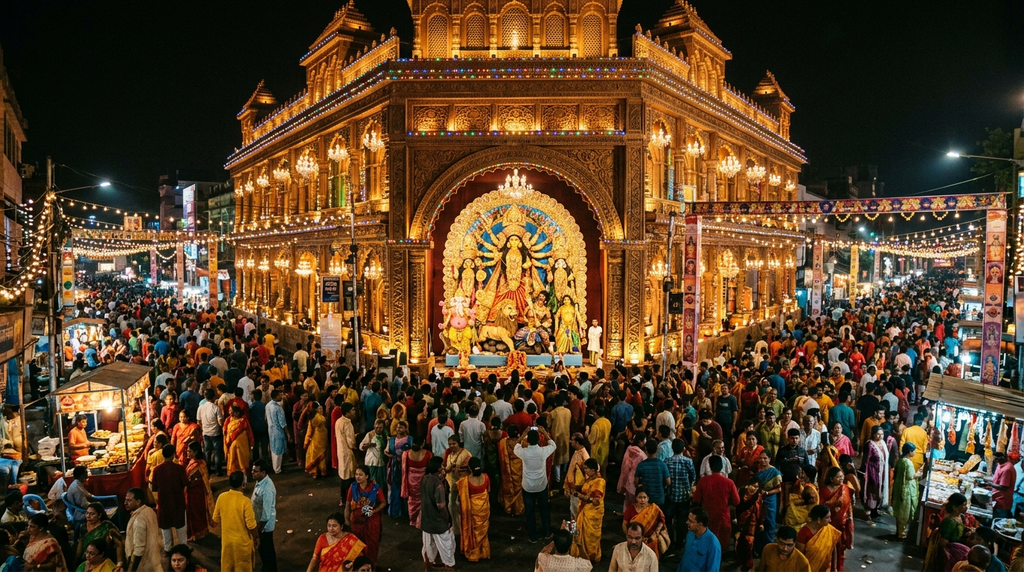
I have been in Kolkata for only a year, living with my son, and I find myself doing what mothers and fathers have done for centuries: transmitting memory through celebration. I show him the rich Bengali culture: Sindoor Khela, devotees, song and dance, rich cuisine. I take him to the Puja pandals. I watch him look at the lights, the crowds, the artistry, the grandeur. I want him to know this city. I want him to understand that cultures are not museum pieces. They are living, breathing, changing worlds. Perhaps this is how migration works. We leave one place. Then we carry that place inside us. Then we learn to love the new place. Eventually, the two places begin to live together within us. Udayagiri lingers in me. Kolkata is becoming part of me. The Dussehra of my childhood and the Durga Puja of my present do not cancel each other. They converse. One is intimate, domestic, rural, familial. The other is magnificent, public, artistic, urban, and culturally expansive.
Between them stands a woman who was once a little girl in a house full of sisters.
Sometimes I think that all our lives are merely elaborate attempts to return to certain sounds. A mother’s voice. A father’s reading aloud. Sisters laughing. The clatter of utensils. The beat of a distant dhol. The sound of relatives arriving at the door. The silence after the prayer. And perhaps, most painfully, the sound that is no longer there. Baba’s voice: “Meera…”
The house in Udayagiri is disappearing into a dilapidated fortress. Baba is gone. Maa is still there. The six sisters have travelled far from the rooms of their childhood; now they have ‘rooms of their own’. The children of those six sisters are growing up in different worlds that their mothers could never have imagined.
And yet Dussehra comes year after year. It comes carrying memory. It comes carrying absences, sweetness, and fear. It comes reminding us that no house remains unchanged, no family remains geographically whole, and no childhood can be recovered exactly as it was. But perhaps that is the mercy of memory. It allows the past to return.
So, when Dussehra comes, I sometimes close my eyes. I can see six girls in new dresses—similar patterns, dresses stitched from floral dress material. And if there is any leftover piece of cloth, that can work for one blouse for Maa! I can see Maa in the kitchen, exhausted but still working. I can hear Baba reading the Sudasha Brata Katha. I can hear the distant dhol. I can hear the ululations and trumpet. And then, that last wail. We run behind our parents. We hide. We hold our breath.
And for one small, eternal moment, the whole world is our little house in Udayagiri. Baba is no more. Maa is still there. All six sisters are still together, virtually though. The sweets are still warm. The new dresses are still new. The house is still standing. And childhood has not yet understood the meaning of goodbyes. Life goes on. “The show must go on!” But somewhere deep within, the Dussehra that we sisters carry with us is mysteriously, heartbreakingly, breathtakingly beautiful.
Prof. Nandini Sahu is the Vice Chancellor of Hindi University, West Bengal. This is a chapter from her Memoir, BEING GOD’S WIFE