The BJP is selling her homecoming as the restoration of free speech in Bengal. But a poet booed off the very same stage — and the climate that greeted her — tell a more troubling story.
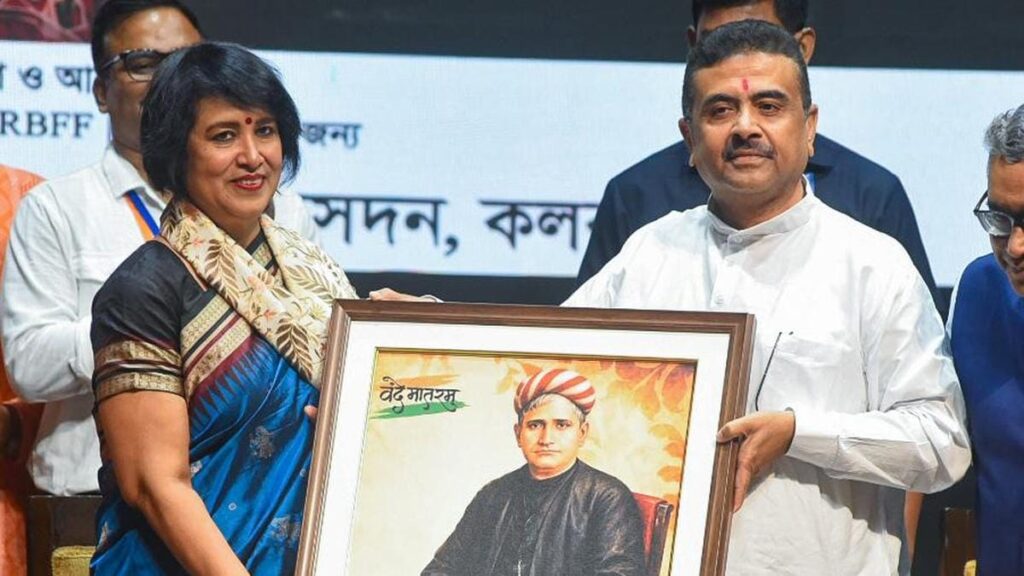
On the first weekend of August, at Kolkata’s Rabindra Sadan, West Bengal’s new BJP government staged a homecoming. The exiled Bangladeshi writer Taslima Nasrin, forced out of the city in 2007, was felicitated at an event pointedly titled “Returning to a Free West Bengal After 19 Years.” Chief Minister Suvendu Adhikari promised her protection whenever she visited and cast the moment as proof that Bengal had entered a new era of free expression under his party. Then something revealing happened. When Nasrin invited the Sahitya Akademi–winning poet Joy Goswami to the dais, a section of the audience — reported to be BJP supporters — booed him down, objecting to his past participation in protests against the Citizenship Amendment Act and the revision of the electoral rolls. Goswami was forced back to his seat; Nasrin’s repeated appeals that he be allowed to speak went unheeded. She later said she felt “insulted.” A celebration of free speech had, in the same breath, silenced a poet for his politics.
That contradiction is the key to reading the whole episode. Nasrin’s return is being marketed as the restoration of liberalism in Bengal. It is better understood as something else — a political project in which the BJP and the RSS deploy a celebrated dissident to advance an agenda that has little to do with free speech and a great deal to do with the place of Muslims in the state.
Her story deserves to be told honestly, because parts of it are a genuine indictment of the very establishment she is now said to be returning to. Nasrin fled Bangladesh in 1994 after death threats over her novel Lajja, which depicted the persecution of a Hindu family by Muslim extremists in the wake of the Babri Masjid demolition. She settled in Kolkata in 2004, calling it her second home. In 2007, as excerpts of her memoir Dwikhandito — already banned by the Left Front government in 2003 — reignited protests, parts of the city convulsed and the army was deployed. Buddhadeb Bhattacharjee’s government asked her to leave.
Bengal’s literary establishment was itself divided over the book, and revisiting its verdicts is instructive. Sunil Gangopadhyay dismissed Dwikhandito as “not literature,” readable, he suggested, only for its scandal. The poet Sankha Ghosh tied the ban to remarks the book made about the Prophet Mohammed that many Muslims found objectionable, while the writer Dibyendu Palit suggested the government had acted on an appeal from Muslim intellectuals who feared the book would foment communal discord; others dismissed it as a prurient fantasy of sexual encounters. The disagreement matters, because it shows the ban was not simple philistinism but a considered decision to place one community’s religious sensibilities above a writer’s freedom. Whatever one makes of the book, that surrender to the street was a free-speech failure — and it was presided over by the very secular-Left establishment that prided itself on liberalism.
But if 2007 exposed the hypocrisy of one camp, 2026 exposes another. For Nasrin’s public record over the past two decades is not simply that of a persecuted feminist; it is also that of a figure whose rhetoric on Islam has grown, at times, hard to distinguish from the Hindu right’s. She has called for madrasas to be abolished, describing some as “factories producing jihad,” and demanded a Uniform Civil Code across the subcontinent. After the 2020 church attack in Nice she tweeted “Boycott Islam,” deleting it only after the Rajya Sabha MP Saket Gokhale filed a complaint with the home ministry. She once suggested that the England cricketer Moeen Ali, but for the game, would have “gone to Syria to join ISIS.” In an interview with The Times of India’s Sagarika Ghose, she claimed that most of India’s secular writers are “pro-Muslim and anti-Hindu.” By her own account, she is unsparing towards Islamic fundamentalism while saying far less about its Hindu counterpart. Her defenders read this as the hard edge of a rationalist’s critique of religion; her critics see the targeting of one community. Criticism of religion, including Islam, is legitimate and deserves protection; the real question is when a particular register — and the political use made of it — slides from critique of a faith into contempt for the people who hold it. What is not in dispute is that the record makes her an unusually convenient symbol for a Hindutva government.
And it is the government, not Nasrin, that has scripted this homecoming. The BJP frames her return as a correction of the Left Front and Trinamool Congress “surrender” to religious pressure. Yet the party now claiming the mantle of free speech in Bengal is fluent in a communal rhetoric of its own. Adhikari has been reported advocating an “Israel model” response against Bangladesh and calling for Muslim MLAs to be “thrown out.” His government’s crackdown on protesters came wrapped in talk of “Jamatis,” “Islamists” and “Friday people” — a vocabulary critics called a communal script. Reports document a rise in anti-Muslim targeting in the state since the government took office. A dispensation this comfortable with anti-Muslim language is not a plausible champion of liberal pluralism; it is using a famous secular dissident to launder that language as courage.
There is a bitter symmetry in this for Bengal’s Muslims. In 2007 they were cast as the intolerant mob that hounded a writer out of the city; in 2026 many of the same people are invited to applaud her return while being told, in the next breath, that they are infiltrators, “Friday people,” a demographic threat to be counted and contained. In both moments the community is the object of the story and never its author — first the villain of a free-speech morality tale, now the silent backdrop to a homecoming staged in its despite. That is the deeper unfreedom the celebration conceals.
There is a geopolitical layer, too. For fifteen years, while Sheikh Hasina governed Bangladesh, Dhaka and Delhi were unusually close. That intimacy ended with her ouster in the student-led uprising of 2024; Hasina now shelters in India, a standing irritant between the two capitals, and the elected BNP government of Prime Minister Tarique Rahman, sworn in early in 2026, is far less aligned with Delhi than her Awami League ever was. Like the interim administration that preceded it, the new dispensation in Dhaka is widely seen as leaning towards China. In that cooler climate, a returning Bangladeshi dissident who is among the fiercest critics of Islamism in her homeland becomes a useful card for New Delhi — a living reproach to Dhaka, a prop for India’s self-image as the region’s shield for persecuted secularists and Hindus, and a quiet instrument of pressure across a border that no longer runs as smoothly as it did. Her homecoming is as much foreign policy as it is culture.
Which brings us to the Bengali bhadralok — the liberal, largely upper-caste elite now applauding the return. If their liberalism is real, it cannot be selective. It must protect the poet booed off the stage as fiercely as the novelist feted upon it. It must extend to the dozens of Muslim families, women and children among them, reported stranded at the “zero line” of the India–Bangladesh border in the government’s push-in drives; to the protesters dismissed as “Friday people”; to a community watching its space in public life contract. Free speech that shelters one celebrated dissident while a whole community is told, in effect, to keep proving it belongs is not liberalism. It is a performance of liberalism.
There is a genuine liberal case for Nasrin’s right to live and write in Kolkata; no one should be exiled by a mob. But that case collapses the moment it is used to license Islamophobia, or to congratulate a government that trades in it. The test for Bengal’s bhadralok is not whether they can cheer a homecoming. It is whether they will insist that the same freedom protect the Muslim legislator, the anti-CAA poet and the family at the border — and whether they will name anti-Muslim hatred as hatred, even when it arrives dressed as free speech. Anything less is not the return of liberalism. It is an old elite’s double game: applauding its own tolerance while the minority’s voice is quietly squeezed out of the very public square the celebration claims to have reopened.
Mehebub Sahana — The author is an academic based at the University of Manchester, UK. He grew up in Purba Bardhaman district, West Bengal. The views expressed in this article are his own.