Somen Sengupta
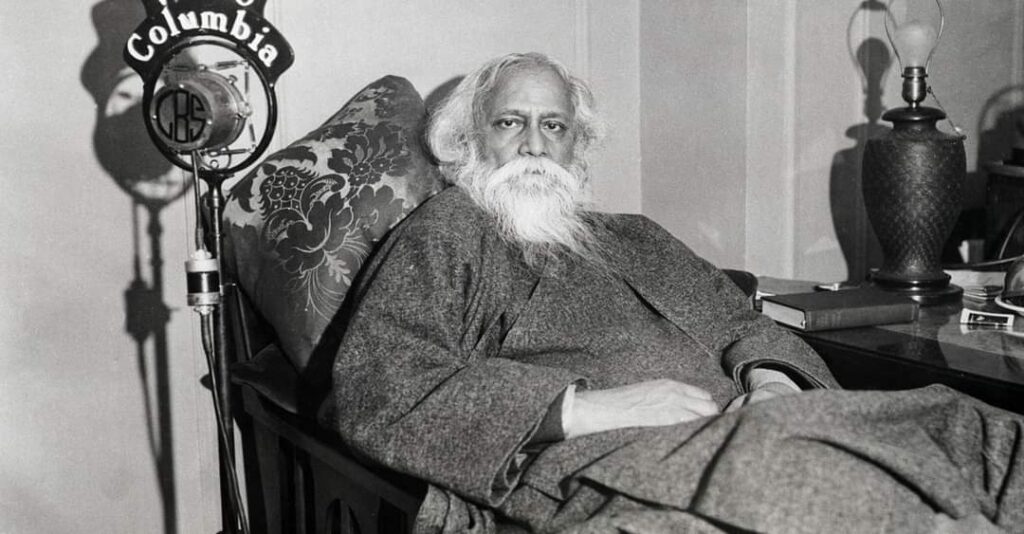
In all of his eight major visits to England between 1883 to 1930 Rabindranath Tagore’s life was blessed with endless memories and enriching wisdom of an universal world that shaped his mind and influenced his world of creativity.
Tagore was born and died as British Indian and his passport carried this citizenship of him till the end. Thus knowing England and mingling more with British world of intellectuality was normal to Tagore who like many of his family landed on the shore of England in 1883 as a 17 years old lad seeking admission to an academic institute to earn a degree.
Destiny did not give Tagore a degree from any British University but it gave him a beautiful world beyond the normal human can hardly think of. Those two year that he spent in England were not fruitless – His exposure to English and Scottish music, poetry, opera and theatre reshaped him into an universal man of letters – Returning back to Bengal Tagore blended these lessons to his own power of creative skills that finally earned him the ambrosia of immortality as the tallest Indian literary titan of modern times.
In his 1912-13 visit to England Tagore won hearts of British readers and social thinkers with his translated collection of poems in English and once his book Gitanjali published by Macmillan hit the stand there was no looking back for Tagore as the first modern literary man emerging from Asia. In 1913 this book earned Tagore the coveted Nobel prize in literature.
Tagore with this became the first modern Indian with a global recognition and fame – The era of Gandhi in South Africa was just started unfolding by the same time.
Thanks to the outbreak of 1st world war from 1914 to 1918 Tagore could not travel to west and his direct scope of interaction with his contemporary global thinkers got scrapped – In India Tagore was watching the global affairs with extra ordinary interest and ventilating his views in articles and letters. At the last phase of 1st world war the history of mankind was practically re-written when in 1917 revolution was broken in Soviet Russia unsettling the rulers of Romanov Dynasty the richest royal family of Europe. Before that Russia’s defeat in the hand of Japan and brutal retaliation of Great Britain over Germany also noticed by the world.
When the recovery and solace of 1st world war not in sight the ruthless aggression of British Government in India was too deplorable.
Forgetting thousands of Indian soldiers who had fallen on the foreign battle fields to protect Great Britain , India’s colonial rulers were executing atrocities specially in Punjab. Such was the degree of brutality executed by British in Punjab that on 13th April 1919 at the city of Amritsar bullets were rained on a peaceful gathering of men, women and children without any warning – It resulted a death toll of 300 plus people in 15 minutes. This massacre in cold blood is known as one of the darkest spot of 200 years of British rule in India.
Tagore reacted this by disowning coveted Knighthood which was bestowed upon him by the King of England a couple of years back to honor his extra ordinary literary talent.
Tagore’s returning of Knighthood was accompanied with a very strong worded protest letter directly addressed to the Viceroy of India. Tagore released the letter in newspaper and it created mayhem across the world – Tough his move was hailed by many people across the border it deeply disturbed most of his friends in England itself – This letter of Tagore was directly underlined as his lack of loyality to British crown under which he was not more than a subject living in a colonized land.
There was another reason that badly dented his popularity in England and it was nothing to do with political gambit. After Gitanjali Tagore translated two more books of him in English. One was Gardener and other one was The Crescent Moon. Sadly both did very bad commercially and Tagore as an author was not highly demanded among readers.
On 15th May 1920 Tagore boarded ship named Merca from Bombay to England with a plan to visit France, Netherland, Belgium and finally USA. He was accompanied by his son Rathindranath, daughter – in – law Pratima and a few more.
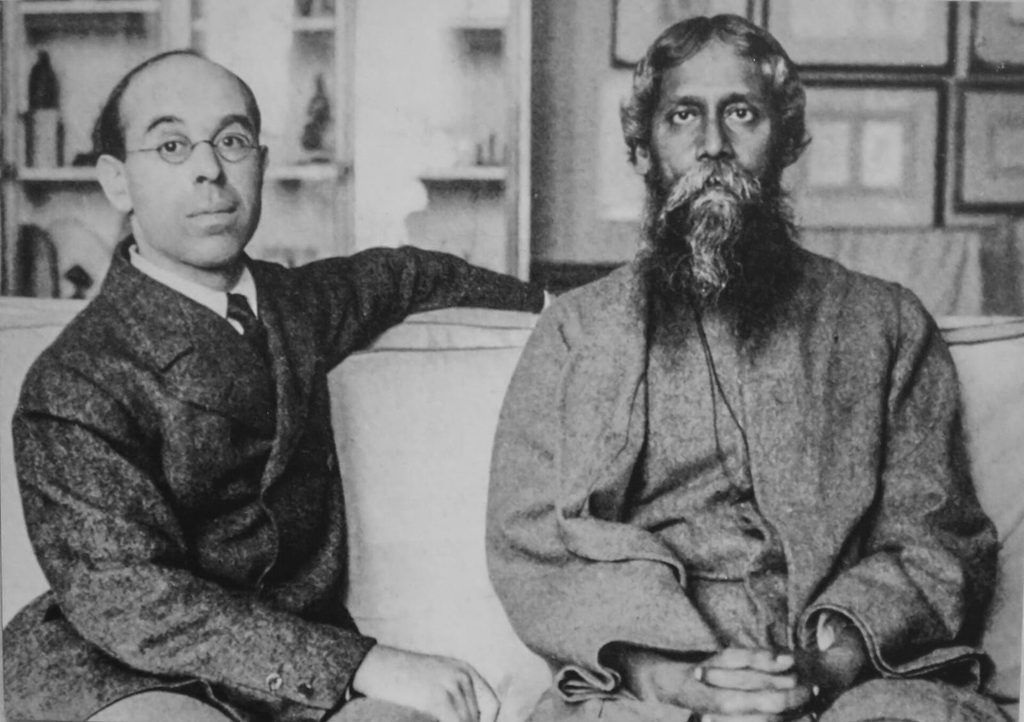
Tagore reached Plymouth port of England on 5th June and from there on 6th June 1920 Tagore and his family members arrived at Paddington station of London. He was welcomed at station by his old friend painter William Rothenstein and his family. Tagore and his team checked in Kensington Palace Mansion hotel.
Soon Tagore’s news of arrival was started spreading and a plethora of people started meeting him with invitation of lunch, discussion, literary session, poetry reading , musical events and formal speeches. Such was his initial engrossment in London that he in a letter to Dinabandhu Andrews wrote “…Do not expect long letters from me, or indeed anything else.The fury of social engagement is on to me.”
From London Tagore visited places like Oxford, Bristol, Cambridge, Petersfield, Mayfair and many other locations. People in England received him well but he found the previous warmness and cordiality are pathetically missing this time. England hailed Tagore in 1912 with open arms but this time there is a thick wall of discomfort between him and common British people.
Soon Tagore realized that his stand against British Government back in India has culminated a deep patch of apprehension about him to the British subject.
Tagore was really heartbroken when he failed to convince his friend Rothenstein regarding the influence on the liberal mind of artists and painters working under the patronage of Government. While Tagore opined that this is not good for the freedom of expression of the artist Rothenstein then Principal of Royal College of Art and also a close friend of British Prime Minister begged to differ.
Tagore realized his open expression of protest against Jaliwanalabagh massacre created an impact. On 19th June 1920 Tagore delivered his speech in Oxford which was very well attended but Robert Bridges the poet laureate of England who was invited in the function skipped it with no specific reason. He later wrote a letter to Tagore and indirectly expressed his discomfort of joining him in the event.
When Tagore was in England the famous Jaliwanalabagh investigation report known a Hunter Commission report was tabled in British Parliament and the long debate on this created sensation in Great Britain.
Before that Tagore visited India Office in London to meet Mr Montagu the secretary of state. Tagore in that meet opined that people of India now like to see whether British people accept it or not that the inhuman treatment executed to Indians in Punjab is against the basic principle of humanity. He specified that the debate on Hunter commission report in British Parliament is a test to the British race.
Tagore also had raised the issue of brutality shown in Punjab to British Tory MP V Cecil and Oxford Professor Gilbert Murray. He became an un-official spokesperson of India to expose administrative ruthlessness conducted by British who claim their conducts as most civilized.
8th July 1920 Hunter Commission Report was discussed in House of Commons and the same was discussed in House of Lords on 19th July.
Both the discussions were enough to disappoint any Indian and Tagore was not an exception.
Though the inhuman tyranny of Reginald Dyer was not supported by the British MPs but no too harsh comment was also delivered in this discussion. Rather almost like a recognition it was said by Montagu the secretary of state to India that : “ Dyer acted to the best of his lights and with a sincerity of purpose , but that he committed an error of judgement”.
In both the house the wounded sentiment of India’s soul was largely ignored and the massacre was discussed one-sided and false in spirit.
This was enough for Tagore to find that English summer unbearable and he soon planned to move to France from where he had plan to visit Netherland and Belgium.
In this sea of bitterness and dismay Tagore had two memorable experience in England of 1920.
One of that was his final meeting with legendary Russian painter Nicholas Roerich who came to meet him on 17th June with his two young sons. Roerich was a staunch opposition to Bolshevik movement and the idea of Soviet implemented by Lenin – He after a bitter tussle with ruling Bolsheviks left his palatial house and massive collection of arts in St Petersburg.
An avid reader of Tagore he and his wife Helena were in touch with Tagore before. On 20th June he painted an exceptional portrait of Tagore and gifted it to him. Tagore was very moved by his paintings. Later on Roerich moved to India. After spending few months in Darjeeling he and his family settled in Kullu valley where he died on 15th December 1947. He and Tagore were in touch till the end. It is just a sheer co-incident that his son later married cine star Devika Rani who was grand-niece of Rabindranath Tagore.
The other experience was even more heart melting.
“War Poet” is a word coined in England during 1st world war when trainful of young lad soldiers were sent to battle field.
Many of these too young British soldiers were talented poet and writers who seeing the endless death of dance before their eyes penned the experience in poetry and other forms of literature. They later known as war poet.
Wilfred Owen was one of the young talented twenty plus soldier poet who was sent to the war front of France where he died at the age of 25 in 1918. When his belongings were returned back to his mother Susan Owen along with his dead body a note book was found in his bag in which a few lines of a poem written by Tagore was found – His mother Susan was surprised to read that lines and recalled the day when she was there to say good bye to her son for last time her poet son recited these lines as a parting message.
Susan Owen somehow came to know that Tagore was in London in that summer. Without knowing his address she just wrote him a letter expressing her son’s devotion to Tagore’s poetry published in Gitanjali.
On the envelope she just wrote name of Rabindranath Tagore with a hope that this letter will be delivered to him – Surprisingly the letter was indeed delivered to Tagore by British post – Such was the magic of Tagore in Europe in 1920.
Susan Owen also expressed his desire to present Tagore a copy of his son’s collected poems most of which were written in the battle field.
Tagore replied to this letter to Susan Owen the grief stricken mother of late war poet and also was kind to receive the poetry collection of Wilfred Owen but sadly his reply letter was never found and the poetry book was also not found in his personal book collection by Tagore biographers.