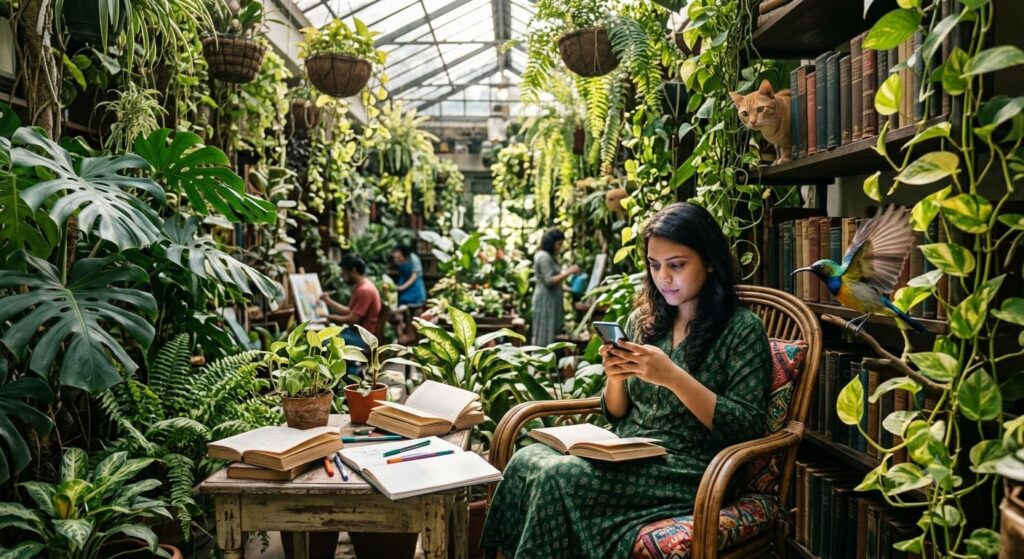
Do you want to have a good time? You can just tap your phone and get a hot biryani delivered to your door in minutes. You can buy new clothes without leaving your bed. You can scroll through endless reels on your phone, watching people dance, travel, and live glamorous lives. You can even talk to a computer program that will act like your best friend. We have more ways to entertain ourselves than ever before in history. Yet, there is a strange feeling of emptiness everywhere. People are constantly distracted, but they are also deeply bored. We have entered a time where we have all the luxury in the world, but we have forgotten how to actually enjoy it.
People often talk about the decline of culture when society gets too wealthy. In ancient times, powerful kings and emperors in India and around the world lived with unbelievable excess. They surrounded themselves with pearls, grand feasts, and wild entertainment. Today, critics often warn that our society is also falling apart because of our modern obsessions. But in the past, some groups of artists actually found a strange hope in these wealthy, decaying times. They created beautiful poetry, rich music, and stunning art. They believed that against the boring rules of normal society, human beings should enjoy pleasure just for the sake of it. They believed that smelling a beautiful flower or wearing a fine silk cloth was important simply because it felt good.
Today, we still have that obsession with luxury, but it has become totally lifeless. We use technology to control everything, and we have lost the real joy of feeling alive. The problem is not that we have too much luxury. The problem is that we treat our lives like projects we need to fix. We want everything faster and in bigger quantities. But speed and quantity cannot replace true happiness.
You can see this clearly in how the richest people live today. Look at the modern tech billionaires and wealthy startup founders. They have all the money in the world, but they live like strict monks. They stop eating normal food and survive on boiled vegetables, handfuls of pills, and strange green juices. They track their sleep and their heart rates on expensive watches. They spend crores of rupees just to stop themselves from aging. In the past, wealthy people would build beautiful palaces filled with art and music. Today, the ultra-rich lock themselves in private gyms and clinics. They treat their bodies like broken machines that need to be upgraded. Because these rich people have so much influence, their joyless way of living trickles down to the rest of us. They make us believe that constantly working and strictly controlling our bodies is the only way to live.
We can also see this loss of joy in how we treat food. Food in Indian culture has always been about community, love, and celebration. Now, the market is flooded with new weight-loss injections and extreme diet plans. Many people are taking these medicines to kill their natural hunger. While these treatments do help some people medically, they are changing our relationship with eating. People complain that they feel flat and tired. They lose the desire to share a joyful meal with their family. When we treat eating as a medical problem to be solved, we lose the warmth of sitting together and sharing a festive feast. We celebrate eating less, rather than celebrating the rich abundance of food.
The same thing is happening to beauty. Young people today are trapped in a harsh online culture where they constantly measure their faces. They look at beauty like a math problem. They obsess over the exact angle of their jawline or the shape of their eyes. Beauty used to be about charm, grace, and human expression. Now, it is a brutal competition. People feel terrible about themselves because they cannot match the impossible, calculated standards they see on their screens. They treat their own faces as something that needs to be punished and corrected.
Technology has taken this emptiness even further. Artificial intelligence can now write our emails, create our art, and even generate festive greetings for our relatives. But a machine does not have a body. It cannot feel the warmth of the sun, the taste of a sweet mango, or the pain of a heartbreak. When we let machines do our thinking and feeling for us, we fill our world with empty content. Pleasure and pain are important because they teach us what is valuable in life. They guide us toward what is good and beautiful. A machine cannot care about anything, so it cannot truly value anything.
We need to remember how to live in our bodies again. The artists of the past knew that life is short and we must appreciate the small moments. Enjoying life does not mean you have to be selfish or careless. It simply means you should pause and actually feel what you are experiencing. We need to rebel against this modern pressure to be perfectly optimized machines. The next time you drink a warm cup of chai, do not just swallow it while looking at your phone. Smell it, taste it, and feel the warmth. We only have a short time on this earth. Our goal should not be to live like robots tracking data, but to feel our lives as deeply as we can.