India was formed with the ideals of liberty, equity and fraternity. Constitution guaranteed us these ideals but for many social groups, these ideals remained just in the papers. The freedom that an average upper caste male practices in this country is not equal of a Dalit’s experience. Similarly, the idea of fraternity becomes different for different caste groups, follower of different faith, different ethnic group, gender, rural-urban distinction and many other membership to social and political identity. Bengali Muslim is such social group whose experience of liberty, equity and fraternity in this country is different from their fellow Hindu Bengalis and North Indian Urdu speaking Ashraf Muslims. Bengali Muslims are one of the poorest social groups in this county, their underdevelopment traces back to the colonial times, exacerbated by partition and failure of subsequent governments in the state of West Bengal till now. Recently, they have become the ‘threat’ to the national security of this country which was given to them as reward for not choosing Pakistan in the 1947 Partition.
Social Justice in Indian constitution indicates three dimensions of freedom and equality — economic, social and political life of a citizen. Even though the constitution makes social justice an obligation of the state, The Bengali Muslim experience since 2025 makes it hard to believable. In this essay, we will locate the Bengali Muslims in the fundamentals of the idea of justice and we will try to understand what does social justice mean for the Bengali Muslims.
Nightmare of Bengali Muslims started in 2019 after the union government announced CAA/NRC/NPR. Massive protests surged the country especially in the Muslim populated areas and in Assam and West Bengal. However, Assam’s reason to protest was different from the Muslim question which was raised by democratic pressure groups and anti-BJP political parties. It was also the very moment when Burmese society successfully cleansed out Rohingya people who had consequently taken shelter in Bangladesh. Assam always had the fear of being demographically replaced by Bengalis (especially Muslims) from Bangladesh. This fear was taken from Assam and was introduced to the whole country by the government and the media houses.
Fear of losing the voting right, becoming second class citizen and the anxiety of being sent to Bangladesh or to detention camps increased amongst the Muslims in the whole country recently. Government leaderships in political rallies started giving speeches about their plans to remove illegal immigrants. However massive protests halted the government from implementing these three acts in the year of 2019. But they slowly injected the fear of infiltration among the apparent secular Hindus of this country through media. BJP ruled Government uses ‘Bangladesh’ as an excuse for the underdevelopment as Navine Murshid argues in her book India’s Bangladesh problem in detail. Questions like stagnancy of Assam’s GDP or the Country’s bad performance is easily crushed by citing ‘Bangladeshi infiltration have stopped the development’. After, the state enemy is created; governance becomes easy for the state. Rousseau’s social contract is thrown away and the society is ruled with absolute governance. This remains mostly uncontested, a big portion of the nation gives consent to eradicate the citizenship of a minority, expecting that, this will bring them economic prosperity. If such is the reality, then it clearly reflects the South African apartheid.
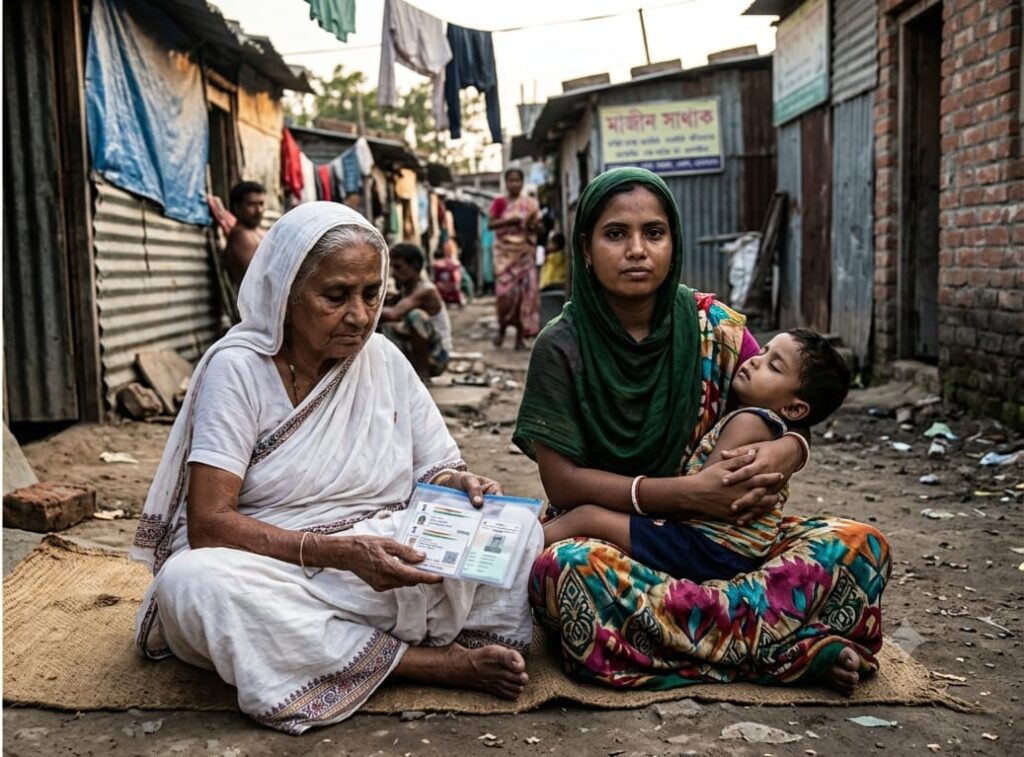
In the year of 2025, home ministry releases a notice named ‘operation push out’ which will be remembered in the history of this country as one of the most heinous and monstrous state orders. Under this order, Government gave directive to Gurgaon police to look for “illegal Bangladeshi immigrants/Rohingyas” and keep them in detention camps. This gave Delhi and Gurgaon Police a license to harass poor Bengali migrants, especially the Muslims. Journalists suggest that their id was checked, they were beaten up, evicted from their Bastis by police and the local right wing mob helped the state one degree more by cutting electricity of their Bastis.
The migrant body is continuously scrutinised, producing a condition where existence itself requires constant proof. and that proof also does not safeguard their wellbeing. At the same time, the operation reflects what Giorgio Agamben conceptualises as the “state of exception”, where legal norms are suspended in the name of security. Bengali Muslim migrants, despite holding citizenship documents, are treated as if they exist outside the protection of law. Their rights are not formally removed but are rendered ineffective in practice. This produces a condition of “bare life”, where individuals are reduced to biological existence without political recognition.
Normalisation of hatred against the Bengali Muslims helped the common masses signify any Bengali migrant to be a Bangladeshi hence he is infiltrator and hence, he is ‘killable’. Very easily, this narrative broke out in the whole country, and right wing hooligans assembled to torture the Bengali Muslims of found nearby. Many cases of ‘lynching’ were recorded last year. Among which falls the traumatic death of a Dalit worker from Chattisgarh who was beaten to death by Hindutva mob in Kerala. Another incident was recorded in Odisha, were Juyel Sk from Murshidabad, a construction labourer was beaten up and killed for being Bengali Muslim. A significant number of migrants returned home after these incidents became more “normal”.
Once Bengali Muslim bodies are marked as illegal or suspect, they become vulnerable to forms of violence that are either condoned or insufficiently challenged by the state. In such contexts, the distinction between lawful authority and mob action becomes blurred, as both operate within the same ideological framework of exclusion. This process can be understood through the work of Achille Mbembe, particularly his concept of ‘necropolitics’, where power is exercised through the capacity to decide who may live and who may be left to die. The migrant is transformed from a worker into a suspect, and from a suspect into a target, which makes violence possible as well as justified.
The word ‘right’ is perhaps a funny word in a regular Bengali Muslim migrant experience. We have discussed many of their rights being illegally and unethically taken away from them. But the denial of ‘Right to the city’ is comparatively a ‘fancy’ one after the discussion on denial of right to life.
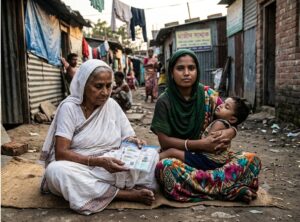
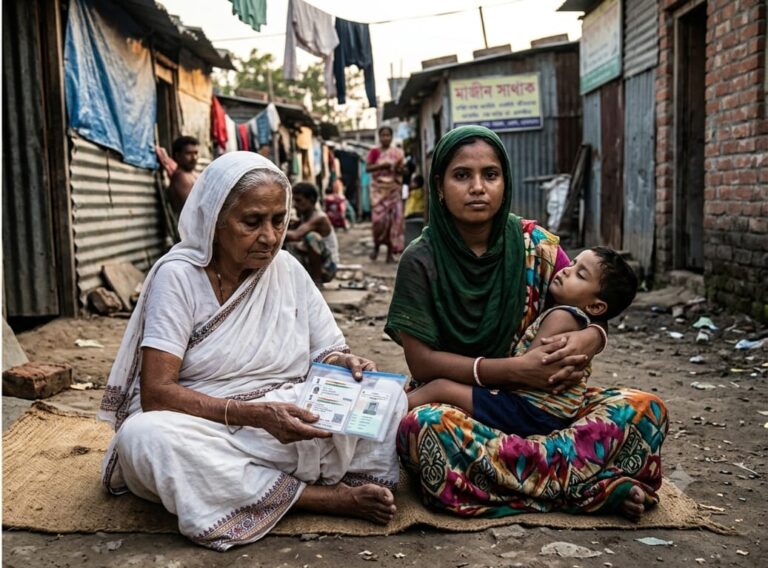
Most of the migrants reside in jhuggi settlements located near construction sites, industrial zones, or elite residential neighbourhoods which are near to their workspace. These spaces are structurally produced by the City’s dependency on cheap labour and continuous exploitation. Bengali Muslim migrants, along with Dalits and Adivasis, occupy these precarious settlements where access to basic services such as water, sanitation, and secure housing remains limited. Their presence is essential for the functioning of the city, yet their right to inhabit it remains constantly under threat.
The repeated burning of settlements, such as the Bengali basti in Delhi suggests a clear pattern of ‘accumulation by dispossession’. These acts are often carried out by local actors, including landlords or right wing groups, and are enabled by the absence or complicity of state authorities. Violence here operates not only to remove populations but also to discipline them, reinforcing their position as temporary and disposable residents of the city. Bengali Muslim migrants are allowed to remain only as long as they serve the economic needs of the city but are denied dignity. Their settlements become sites where class, caste, religion, and state power intersect, producing a form of urban existence that is deeply insecure and constantly exposed to violence.
A famous wall painting became viral during BLM movement, though the saying was nothing new to American society. It said, “Who do you call when the police kill?” probably the same thing was thought by Sunali Bibi who was sent/deported/pushed back into Bangladesh despite of having Voter ID, Aadhaar Card, Pan Card, Bank Passbook and Ration Card.
Sunali Bibi, along with her husband, brother-in-law, son, and several neighbours, was detained by the Gurgaon Police following their participation in protests against the fire that had devastated their basti in Rithala. The family was held in a detention centre for a period before being forcibly pushed across the border into Bangladesh; protestors feared this deportation and left their cry for the demand of Right to the city. Many of the other Basti dwellers left during this time. Sunali Bibi and her family crossed the jungle, begged in the Streets of Dhaka for food, and then put in Bangladesh Prison — as they were actually “illegal immigrants” from India, though unwillingly. Her father, with help of an MP filed a case in high court, submitted all the documents there and got the order of their safe come back. However, Central Government challenged that verdict to the upper bench citing security concerns. They stayed in Bangladesh for four months. Will the Central government and Police ever be held accountable for the injustice they unleashed upon Sunali Bibi and her family?
This is clearly not an administrative error but a structural condition where legality becomes uncertain and reversible. The case exposes how citizenship can be suspended through bureaucratic action, and how vulnerable populations are forced to depend on prolonged legal struggles for the restoration of basic rights. The Constitution is not only a legal document but a moral commitment to justice, equality, and dignity. The deportation of a documented citizen directly contradicts this principle, suggesting that constitutional morality is being overridden by administrative and political priorities. It demonstrates a collapse of justice where the burden of proof and survival is shifted entirely onto the individual, while the state remains largely unaccountable.
All of these incidents could be seen as a pretext to the future fate of Bengali Muslims of this country. State and Media has normalised the dehumanisation of Bengali Muslims to an extent that a large number of voice in the country believes in the dehumanisation process and secretly believes it to be fundamentally necessary for the development of this country.
The final fate of Bengali Muslims is to become second class citizen in this country. And with that agenda, election commission, a constitutionally independent body of the state, has deleted millions of people from voting parole just in west Bengal. These deletions were particularly high in the Muslim blocks. Central government is giving a gentle message to the people of this country that they can come in power using whatever tools that can help them and they are coming in power without the decision of the minorities of this country. The deletion of millions did not make much impact in the campaign of election boycott by opposition parties and on the other hand BJP and the Civil Society of West Bengal celebrated this election as the most free and fair election of the recent decades. In simple words, the Civil Society and the major opposition parties actually did not bother thinking about Bengali Muslim migrant experience.
What is Justice?
Social economic or political – three of the parameters of justice could not reach Bengali Muslims. They remain one of the poorest in the country, with only 2.6 percent participation in government jobs, with zero political representation in parliament currently. Equality, liberty and fraternity – nothing has reached them. Bengali Muslims are not considered Bengali around Bengali intelligentsia that is dominated by the bhadraloks. Zakir Hussain Raju in his Bangladesh cinema and national identity book (2014) explores this theme where he argues that a Bengali Muslims’ ‘Muslimness’ would not allow him to be a Bengali despite being great in that language, whereas a Hindu who might not want to associate with Bengali identity for example a Sylheti Hindu, would still be considered a Bengali. Equally, a Christian might be respected only if they posses foreign blood, Adivasi Christians and Bengali Christians would not have any stake in Bengali academic and cultural circles.
This remains in a Bengali Muslims lived experience where they have to constantly prove their Bengali-ness. And from that lived experience they know, it will never be enough. The most fascinating part is, Bengali society that is known for its resilience and integrity – did not fight on streets for their migrant worker brothers and sisters. They remained silent when Sunali Bibi was in Bangladeshi prison. This is the very society that has given huge protests for Vietnam, but stayed in their home when the Bengali Muslim migrant workers were mob lynched. During election, when 90 million Bengalis were removed from voting list, media repeatedly showed the dietary habit of the candidates. Bengali Media remained completely silent while the above incidents happened. And right now when small business shops are being bulldozed, inflation is at home, corporate is looting the natural resources of the country, numerous scams happening — media has turned itself into a TMCP-fun-maker-institution that’d keep the people of Bengal entertained.
So what is Justice to Bengali Muslims when their identity has become a threat to the state, their body is killable to state, their formal proof of citizenship does not guarantee their safety and their voting rights do not matter? Does the state still expect their patriotism?