
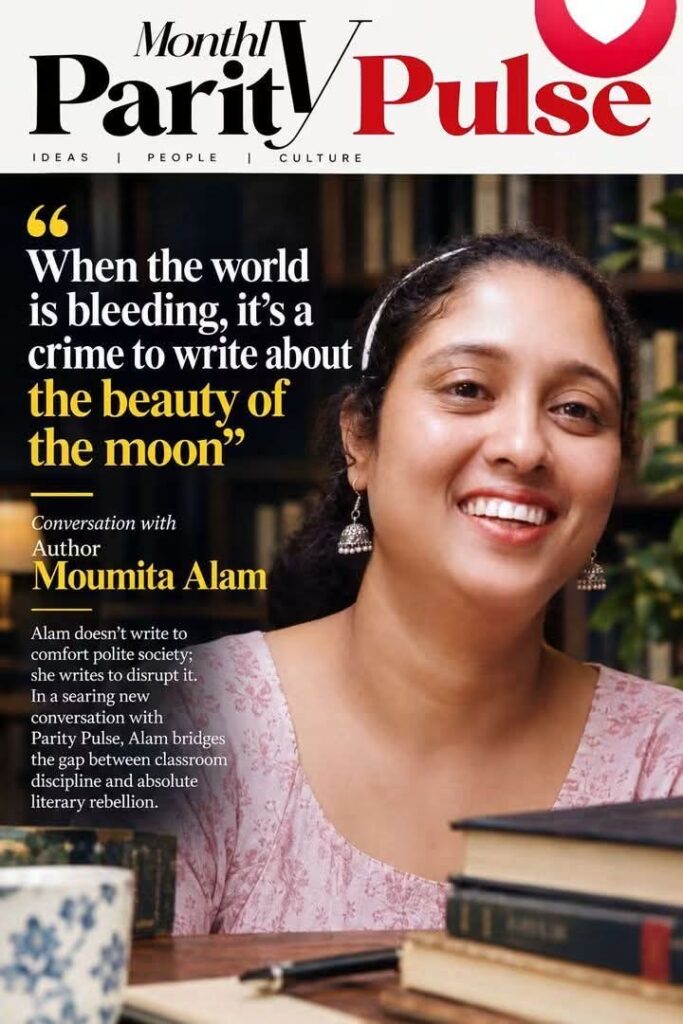
When The World is Bleeding, It’s a Crime to Write About The Beauty of The Moon: Moumita Alam
Author Moumita Alam doesn’t write to comfort polite society; she writes to disrupt it. In a searing new conversation with Parity Pulse, Alam bridges the gap between classroom discipline and absolute literary rebellion. You exist in two very different worlds. The classroom demands discipline, while your poetry demands absolute rebellion. Do these two identities ever clash? Ans: I don’t think these two worlds are different. Both these worlds need dreams, dreams for a better tomorrow, dreams for an equal world. Yes, the classroom needs certain disciplines but those never come in my way to the dream for an equal world without oppression. Rather I would want my students to get infected by the dream, i want my students to ask more questions to make the system uncomfortable. You write fiercely about the marginalized. But literature is often consumed by the privileged. How do you stop your work from becoming mere tragedy consumption for the elite? Ans: you are right. This question haunts me too. I don’t think my works are consumed as tragedies by the elites. I don’t think they dare to read my works. My words unsettle them. And I never think my work is done by writing only. I go to the ground, connect people. I dream that someday all the have nots would crush the empire of the obscene riches. That brings us to your craft. Systemic oppression is brutal. Do you find that polite, conventional literary aesthetics are simply inadequate to capture this reality? Ans: See I don’t believe in Arts for art’s sake theory. I believe, when the world is bleeding, it’s a crime to write about the beauty of the moon. My poems stink. You are known to be a deep reader. Texts inevitably shape our politics. Which specific historical or subaltern voices do you find yourself arguing with, or leaning on, when you write? Ans: I think my Life has shaped my politics. The struggles of the people around. But I am an ardent reader of the works of Arundhati Roy. But at large I believe it’s the lives and struggles of the people I live with that have shaped and still shaping me. Your poetry is rooted in very specific, local realities. Yet it has gained massive popularity across South Asia. Why do you think your local dissent crosses these transnational borders so easily? Ans: See as humans we might not have the same happiness but unfortunately our pains are the same. I don’t know whether my poems have gained massive popularity or not but if the poems have reached some people then the reasons are we, the common mass, are facing the same authoritarian regime, hatred, fascists and climate crisis. South Asia shares a long, collective history of trauma and displacement. Do you feel the unhealed wounds of our historical past still dictate the systemic exploitation you critique today? Ans: Yes of course. The wounds have never been acknowledged. The first step to healing is to acknowledge the existence of the wounds. But in the sub continent the political leaders all over the spectrum have kept the faultlines alive to draw political mileage out of the faultlines. Germany has holocaust museums. How many partition museums do we have? Society readily labels you a non-conformist. But intellectual defiance carries a heavy personal cost in our part of the world. What does this rebellion look like for you on a mundane, everyday level? Ans: I must appreciate you for this question l. I think this poem answers the question: The Price Of Freedom If you choose freedom you have to pay- they say. I pay for mine. I pay in expletives. My father calls me rebel My mother calls me Bad girl. The society calls me, Fallen And my ex calls me Arrogant bitch. My sister calls me a failure for failing to seduce a husband. My country calls me Anti-national. I call myself a free woman. We live in an era of exhausting socio-political news. How do you confront this daily bleakness without letting despair completely paralyze your pen? Ans: See despair is there. So many things are happening around. As a Nashya Shaikh Dalit Muslim Queer Woman and a mother of a girl child every identity of mine brings new levels of marginalization, oppression and persecution for me. But I believe at the end of the day what remains is Hope. And I am the witness to my time. Sometimes I feel numb. But Resistance is the only way forward. Beyond the critique, you actively demand an egalitarian society for the present have-nots. Stripping away the political rhetoric, what is the very first psychological shift we need to make as a collective? Ans: This is a very important question. I think capitalism and fascism both need isolation. Both these monsters want us to remain isolated. And the first psychological shift we need is to think of ourselves as “We.” I, Me, Myself—is neo liberal linearity. We need to think beyond “I, Me, Myself.” We need to reach out to each other. So I always look forward to working class people. The middle class is the greatest consumer of hatred and market. This class is the rotten class. But I still find hope among the working class people. Suppose you have a small piece of land in a village you can’t cultivate it all alone. You have to rely on your neighbours for a tractor, for water or for other help. So still in villages you will find people are not that isolated as in cities. Let us look inward. Beneath the rigorous critic and the angry poet, there has to be a core of radical empathy. What exactly sustains that empathy in such cynical times? Ans: My relentless belief in Love. I don’t know how but after every heartbreak, after every failure, after every bad day I wake up to fall in Love again. I never give up on Love. Love in various shapes and forms. Here I would love to quote a line from my poem, Love always wins defeating ruins. Let’s not give up on Love and Hope.